Justified Trust
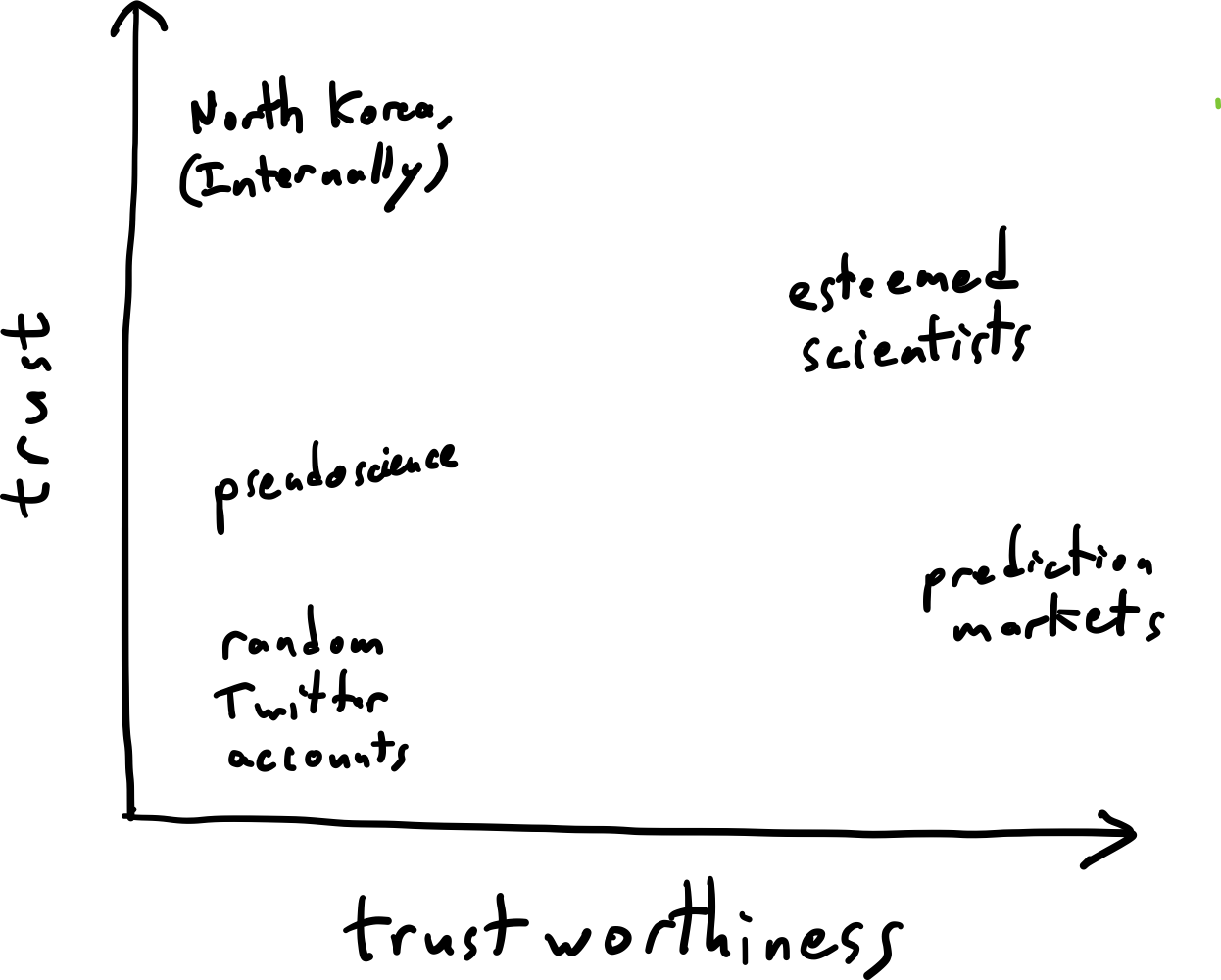
Totalitarian regimes are trusted by their civilians, but they shouldn’t be. They use propaganda and force to ensure trust. They are trusted, but we can say that they aren’t trustworthy. This is called unjustified trust.
Some intellectuals are intelligent and accurate, but are either barely known or incorrectly dismissed. If only they would listen. These intellectuals are trustworthy but not trusted. This is a shame, because no matter how valuable these people could be in theory, their knowledge won’t translate to action.
So, trustworthiness without trust is useless, and trust without trustworthiness is harmful. We can draw this in a diagram:
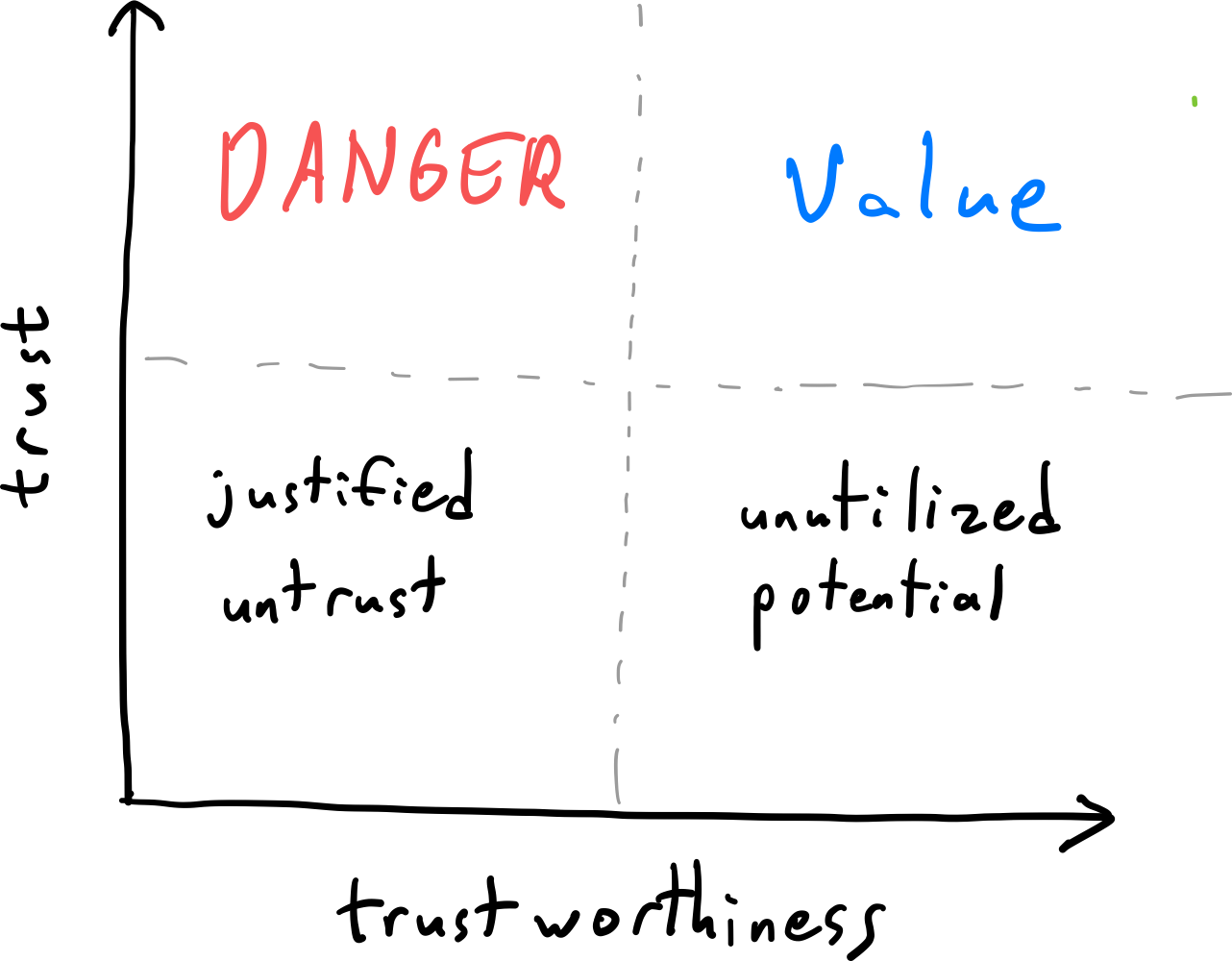
Here, with a few examples:
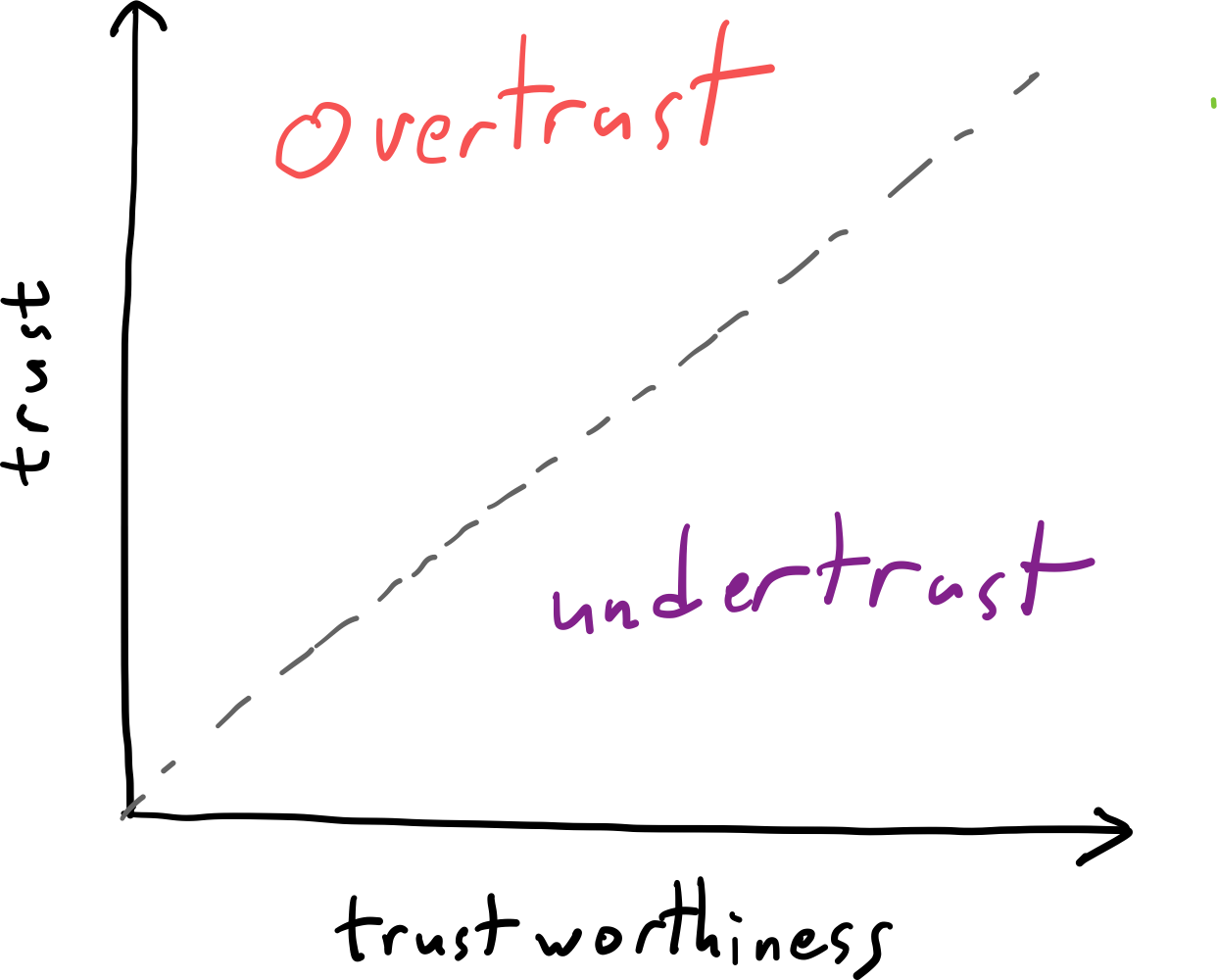
We can say that if groups are trusted more than they are trustworthy, they have overtrust. And if they are trusted less, they have undertrust.
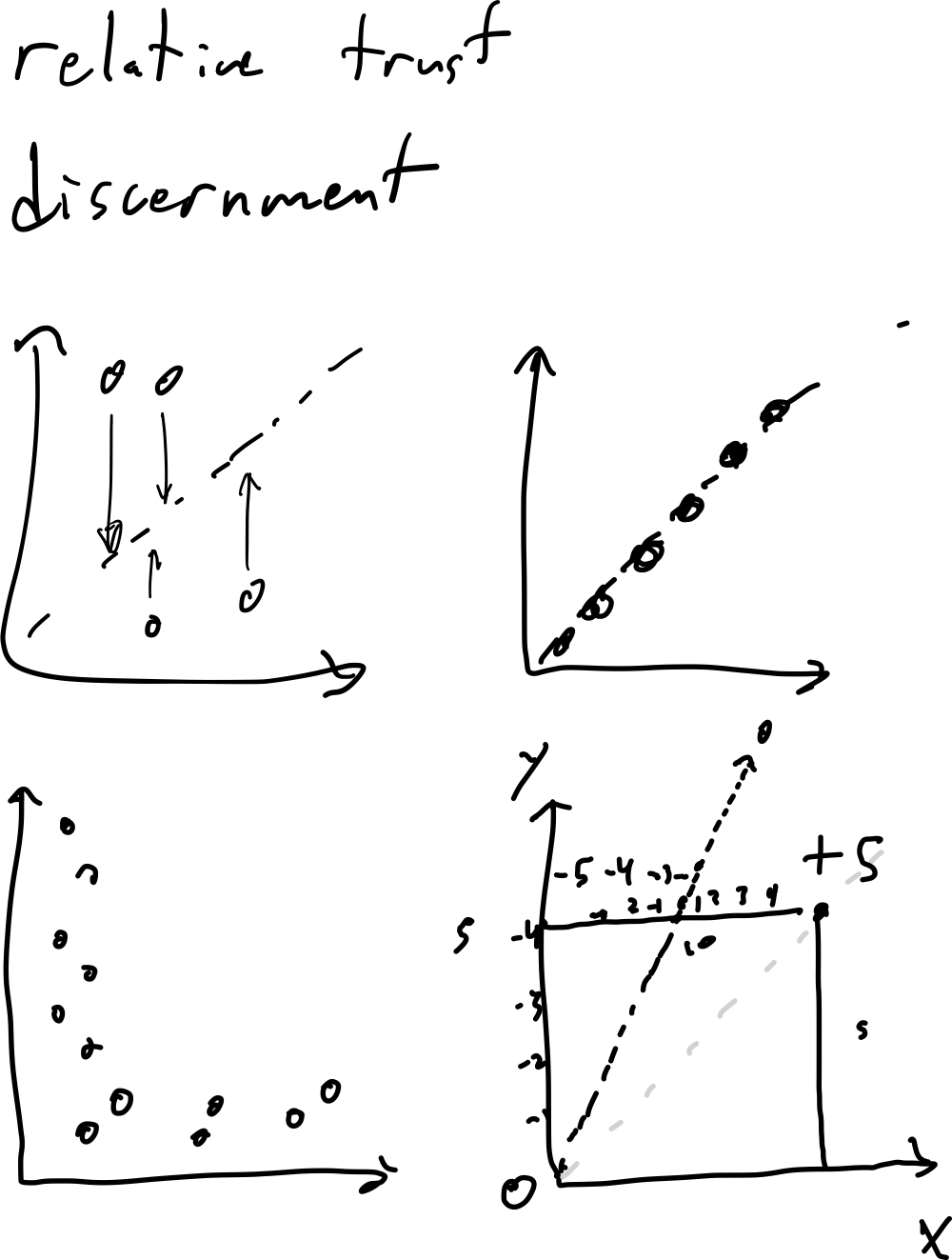
These terms should be understood selectively. An individual trustworthy in parts of Aerospace Engineering may not be trustworthy in Economic History. A Think Tank trusted by American Sociologists may not be trusted by Japanese Economists.
Any measure of trustworthiness would be subjective and dependent on the perspective of a given person or group. This doesn’t mean that it’s useless, but rather that it’s complicated. You can redefine “trustworthiness” as “trust by a specific 3rd Party.” For the sake of this document, “trustworthiness” means how trusting you, the reader, would be, given my expectations of the readership.
There are situations where trustworthiness leads to trust. There’s a connection there, but it’s often fairly weak. Scientists have a long history of accuracy that’s led to a fair amount of respect, but they still have a long way to go. Maybe for the TED-talk intellectual audience, for every 10% increase in trustworthiness, a group gains a 2% bonus in trust. Not as high a ratio as boosting academic credentials or sounding confident, but something nonetheless.
Justified Trust in Politics:
American libertarians often argue that governments are not trustworthy. Liberals in favor of big governments seem to think that governments are good enough. I hear relatively little from either about how we can measure and improve justified trust within governments.
There are a bunch of powerful tools only available to governments. If governments aren’t trustworthy the tools will be used for destructive ends. For instance, the American public supported the Iraq War based in large due to overtrust. On the other hand, if governments aren’t trusted, the public won’t allow them to do things. You can see this as American governors are scrambling to fight criticism around basic COVID-19 precautions. This has been mostly a problem of undertrust (though there has definitely been overtrust to encourage this undertust).
So, if governments are not trusted they are powerless, and if they are trusted but not trustworthy they are dangerous. But if somehow, just somehow, they could strike that magical balance of both, it seems to me like it’s difficult to imagine just how good things could be.
On Forecasting
Much of forecasting research focuses on improving accuracy and calibration; on increasing trustworthiness. It’s all kind of useless if other groups don’t actually trust these methods anyway, and generally, they still don’t seem to.
Deferred Trust:
If I trust an expert on matters of nuclear power more than I trust myself on the issue, I would defer questions in the area to that expert. If identifying an expert is challenging, I would find an “expert in identifying experts” and defer to them. If a decent aggregation is available that seems more trustworthy than any individual, I would use an aggregate. Being skilled in assessing trustworthiness seems much higher leverage than being skilled in doing direct research and evaluation.
There are some topics near me where I’m much more knowledgeable than others. I know my personal history and preferences better than anyone else at the moment. But these topics are also those where I expect to be the most biased. If the cost of educating a 3rd party on my knowledge were low, then deferring to them seems generally like the superior option.
Trustworthy vs. Trusted
We can’t discern the trustworthy from the frauds.
If individuals are trustworthy but not trusted, they can’t provide much value.
I want to live in a society with competent leaders who’s competence is trusted.
If you only have one of the two things won’t work well.
I’ve heard that phrase “justified trust” get used here and there
Contemporary
Incremental vs. Radical
Thinking tools…
Overtrust and undertrust
Epistemic deferring
Highly defensible work with low generalizability
https://en.wikipedia.org/wiki/Wikipedia:Avoid_Parkinson%27s_bicycle-shed_effect
Avoiding Undertrust and Overtrust pdf
Other topics
Convenient vs. inconvenient truths / beliefs
Section titled “Convenient vs. inconvenient truths / beliefs”-> Truths that’s EV-negative to the “closer party”, though maybe EV positive to a different party.
“Value
Most medical professionals operate under unjustified trust