Decentralization, Candidness, and Privacy: Pick Two
Introduction
Section titled “Introduction”I’m frustrated by the lack of candidness around Effective Altruist organizations and individuals. Upon reflection I think this may in large part because of community values of decentralization and privacy. It could be that decentralization and privacy can’t exist with candidness, and we will need to decide on some tradeoff between the three.
There are many stories of Steve Jobs being extremely candid with employees. Similar is true for most top tech executives and many well performing companies. Candidness often comes with overconfidence and occasional rudeness, but it seems to have a good track record of getting results (especially when it can be done gracefully).
It even comes up in places you may not expect it. It seems like Seinfeld was great in part because Larry David was brutal at filtering mediocre comedy ideas.[1] Anna Wintour was so brutal she inspired a movie, though I might recommend the documentary.
So theoretically we could just find or promote our own Steve Jobs or Anna Wintour or two to call out all of their thoughts on mediocre Effective Altruist nonprofits and ideas, but in practice I don’t think this will be easy.
One key reason why Steve Jobs and Anna Wintour could be candid is because they were talking privately. It’s one thing to be mean to someone in a room of three, it’s another to do it online for all of their future potential employers and collaborators to see. Public negative speaking about an employee makes everyone look bad, even if it’s warranted. I’m sure that if Steve Jobs couldn’t have privacy he’d give much less criticism, and Apple would have been worse off for it.[2]
Right now Effective Altruism meta and longtermist nonprofits currently have a few norms:
- Organizations are very small and relatively independent from each other.
- If there is important multi-organization discussion, it is made transparent (posts on the EA Forum or on organization websites).
- Discussion should be highly respectful to individuals and organizations. The privacy of these agents should be respected, so important negative information shouldn’t be posted publicly.
All of these are quite reasonable on their own, but together create some challenges. It makes any sort of candid communication very difficult.
Decentralization, Candidness, and Privacy
Section titled “Decentralization, Candidness, and Privacy”I think that communities can choose two, and only two, of the following: decentralization, candidness, and privacy. Achieving all three seems nearly impossible to me with current technology and culture.
Decentralization
Power is distributed between agents.
Candidness
Important honest and negative information is conveyed. This often means the faults of projects, organizations, and individuals.
Privacy
Candid information is not widely shared.
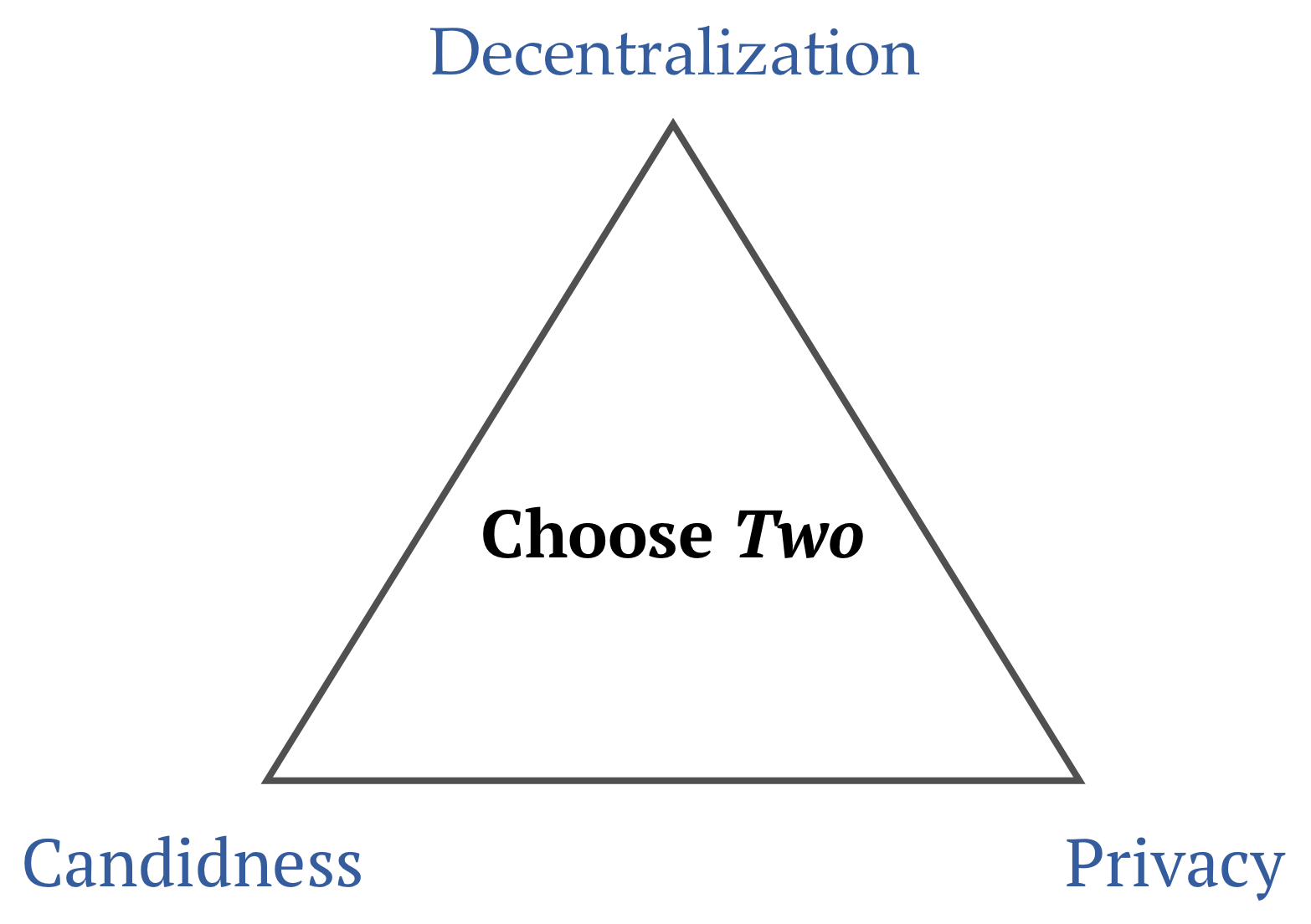
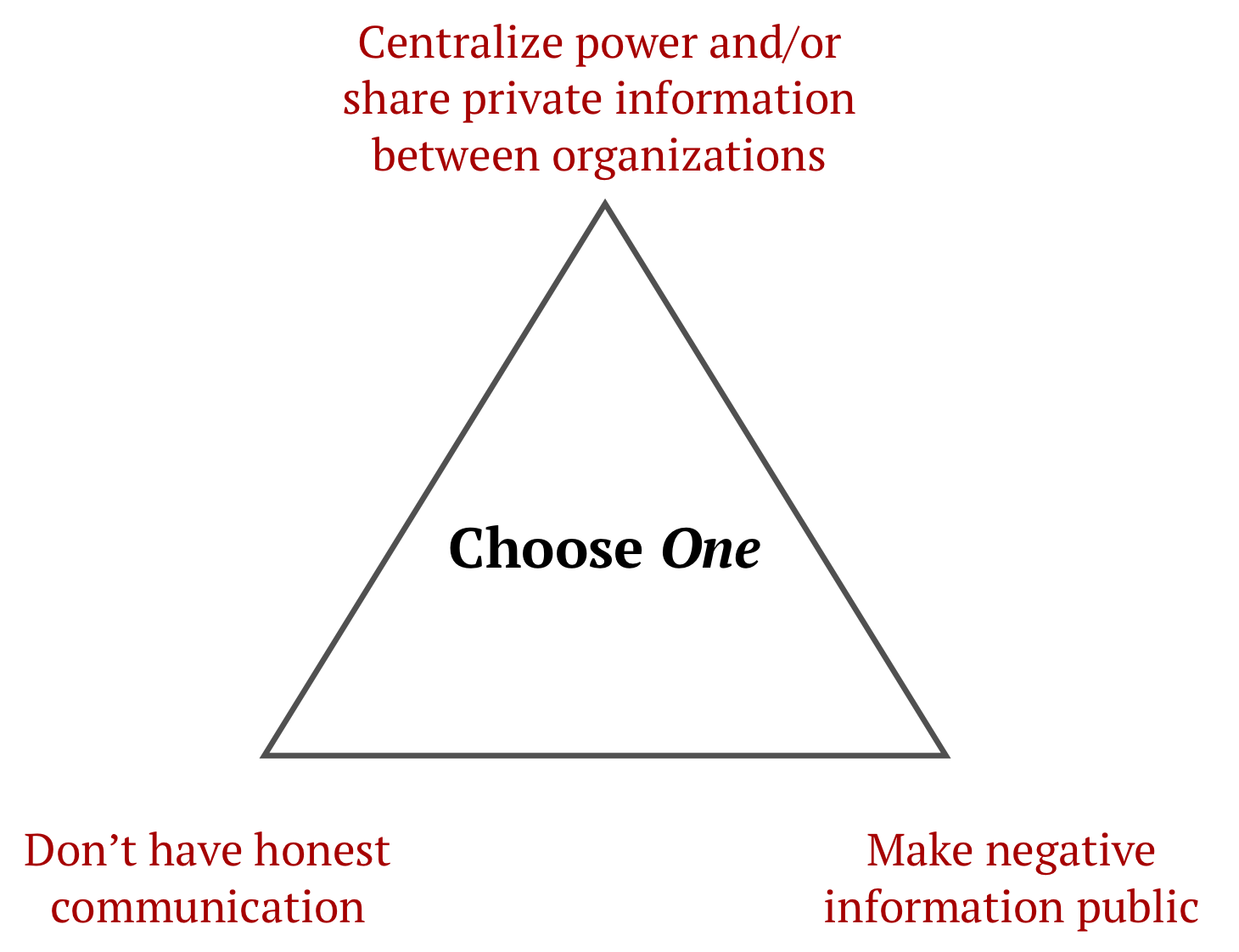
We can imagine what each choice of two looks like:
Decentralization & Privacy
Power is decentralized between a bunch of groups that are very polite to each other. If some of them start behaving or doing poorly, it takes a long time for anyone to notice, and much longer for it to be public knowledge. Because candidness isn’t public, there’s probably a fair amount of gossip to make sure that bad things are shared somehow.
Examples: Social groups, families, business events, nonprofit communities
Candidness & Privacy
Lots of criticism is given, but the necessary information is kept close to the few people at the centralization organizations that need it.
Examples: The insides of high performing companies, like Apple or Amazon.
Decentralization & Candiness
Decentralized candidness seems rare. Perhaps one key determinant is if important knowledge is fairly evident, even about those who do poorly.
Examples: Professional sports teams, competitive and simple businesses that compete on select metrics, comparisons of startups seeking venture capital.
What would a version of Effective Altruism look like in each one?
Decentralization & Privacy
I think this is basically the current situation.
Candidness & Privacy
Organizations would either merge together or there would be some powerful communication network between organizations that was kept private from the public. Both setups would require a lot of coordination and the giving up of some independence.
Decentralization & Candiness
Effective Altruist organizations and individuals are expected to be honest and accepting of a whole lot of transparency, much more so than other organizations. Many of the negatives of both would be on full display, including the “dirty laundry” of organizations and the health problems of individuals. An analogy would be to expect the same amount of available public information as public sports figures and celebrities.
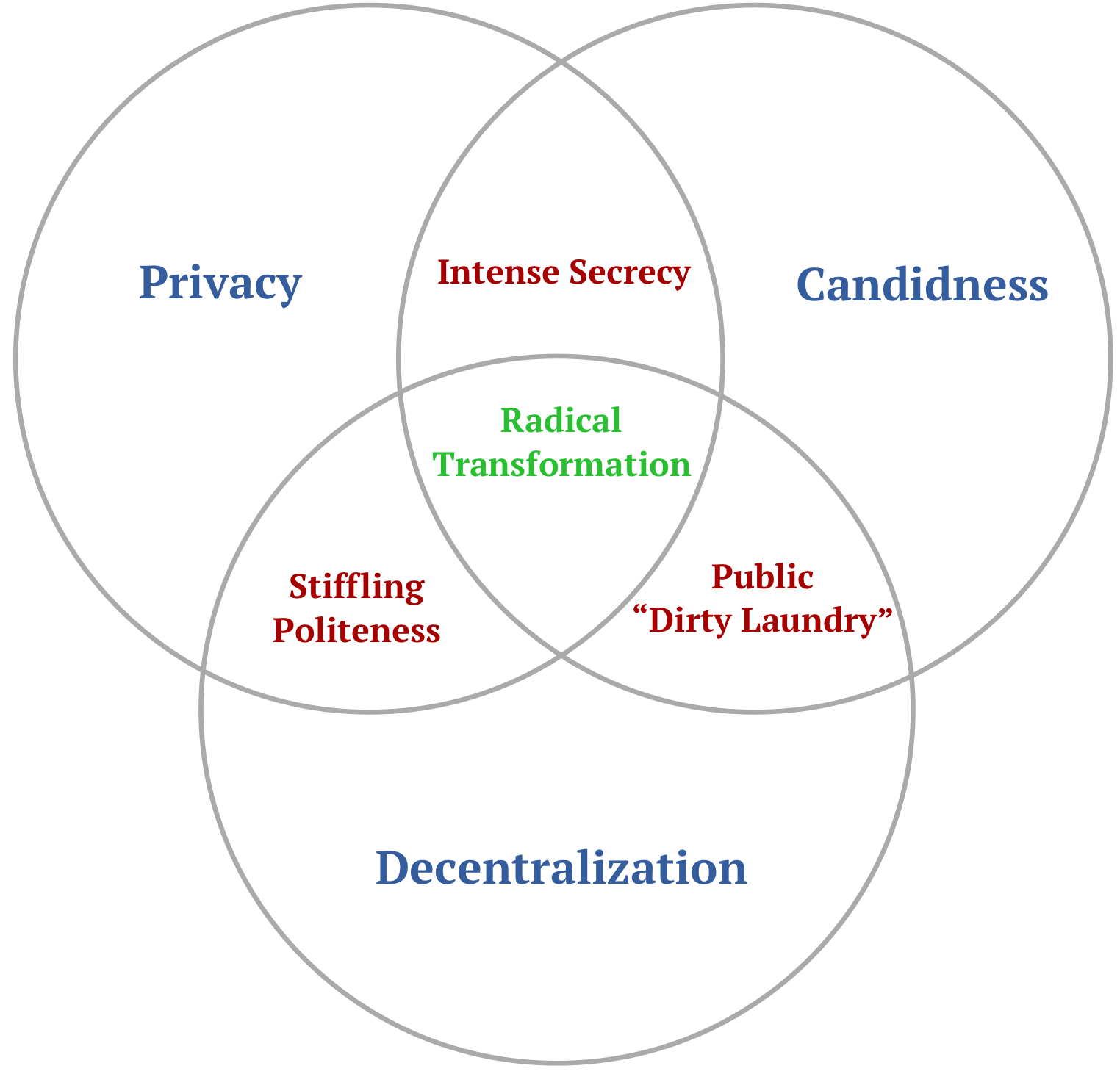
What would more intense candidness look like within Effective Altruism?
Projects
If a project has some substantial negatives, these would be evident, even if on the whole the project was decent and those negatives would be bad for publicity. Projects would be compared cross-organization. Many projects by new people would probably get very low scores, and this would be very evident.
Organizations
Organizations would be ranked with scorecards or similar. Organizations that seem very ineffective or harmful would be labeled as such in ways that all important decision makers would pay attention to. If things are decentralized, the “important decision makers” likely include anonymous donors, so this information would need to be public.
Individuals
It can take quite a lot of work to evaluate if someone will be a good employee. One might learn a lot about them over time, both by working with them and by hearing about them. Candidness about candidates means that the good and bad qualities (real or perceived) of candidates would be widely shared. Imagine per-person scorecards that rank people on many different qualities.
What do I think we should aim for?
Section titled “What do I think we should aim for?”My quick guess is that we’ll want sacrifices from both decentralization and from privacy, but around 3/4th from decentralization. One could imagine a new initiative that would provide honest assessments of projects, organizations, and individuals, but only share these with the most important decision makers.
I’d like to see experimentation with sacrifices of privacy. Perhaps a few individuals and organizations can experiment with extreme transparency. Maybe there should be monetary subsidization or similar for this kind of openness.
Key Questions Going Forward
Section titled “Key Questions Going Forward”- Does decentralization, candidness, and privacy really represent a trilemma?
- Is there a more useful model for understanding the tradeoffs between these?
- Where along the spectrum should we aim for?
- Can future technical or social technologies dramatically improve the Pareto frontier?
Related Work
Section titled “Related Work”Wikipedia has a nice page on Trilemmas. This post was originally inspired by the CAP theorem in computer science. When I was in college, a common phrase was, “grades, being social, sleep, pick two”.
The Zizek Trilemma was about loyalty, honesty, and intelligence. It was specific to Communist regimes, but seems somewhat similar to this one.
Most of the trilemmas I know of seem like crude simplifications. For example, the “grades/social/sleep” trilemma has been further broken up, and I imagine will eventually be made much more intricate. As such they can still be useful, but readers should keep in mind that they are discussing a map, not a territory.
[1] See this documentary, especially the bits from 4:35-5:54 and 15:53-17:27.
“He was solely focused on making a funny show. So that was what he saw and zeroed in on all week… and if things got in the way, he would bat them away ferociously.”
Arguably, Larry David was so unusually candid that he was able to turn his personality into its own 10-season comedy.
[2] Note this is the case if only one company couldn’t have privacy. If all organizations couldn’t have privacy when it came to criticism, I would think it would become much more culturally accepted to be candid publicly, but this would be a radical cultural change.